Findings Orchestration

Turn Diagnostic Findings
into Completed Care.

Findings orchestration is the operational process of identifying clinically actionable findings, converting them into clear next steps, coordinating the workflows, and tracking every case through completion. It is what closes the gap between a documented result and a patient who receives the care that result calls for.

Built for Every Follow‑up, Every Time

Follow-up care is a cornerstone of effective healthcare. Using Inflo Health, hospitals and imaging centers can facilitate communication, deliver personalized care, and drive patient satisfaction. Our solution is the only follow-up platform purpose-built on the principles of high reliability—helping reduce liability, streamline operations, and enhance care quality. Because of this robust foundation, we power follow-up programs for some of the most complex and challenging patient populations across the U.S.

27X
Average ROI reported across Inflo’s portfolio
95%
Reduction in manual tasks
100%
Of actionable findings managed
60‑90days
To begin closing care gaps

Orchestration within Inflo

Actionable findings,
identified automatically.

Inflo Health reads every report and surfaces every actionable finding. There is no change to the radiologist or clinician workflow.

Workflows that adhere to your protocols

Each actionable finding is routed automatically into workflows created to adhere to your organization’s protocols and standards.

Automation closes the loop

Inflo facilitates movement across the follow-up journey for patients and providers, and only escalates to a human when needed.

Every patient is tracked,
reported, and analyzed

Inflo delivers detailed visibility into program performance, operational opportunities, and financial impact.

This is Results-as-a-Service for care completion.

What Is
Results-as-a-Service?

Results-as-a-Service is a delivery model in which the vendor is accountable for outcomes, not just software usage. Unlike traditional SaaS, where the health system purchases a tool and assumes responsibility for adoption, workflow change, and results, a Results-as-a-Service model combines technology and human execution to ensure that a defined outcome (in this case, closed-loop care completion) actually occurs.

If the loop does not close, the job is not done.
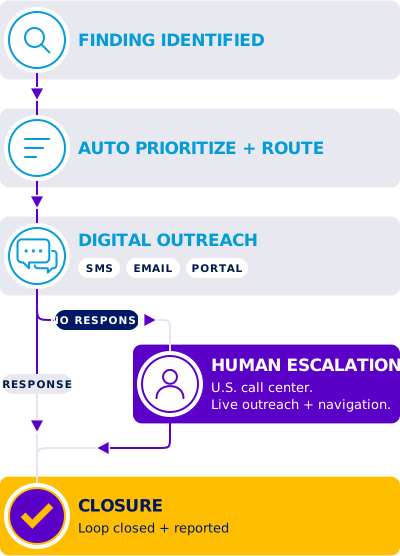
Diagram of five steps: a finding is identified, prioritized and routed automatically, followed by digital outreach by text, email and portal; when there is no response, a U.S. call center takes over with live outreach, and the loop is closed and reported.

Why Do Diagnostic Findings Go Unresolved Even After They're Identified?

Most health systems do not struggle because they lack findings. They struggle because too many clinically meaningful findings enter fragmented workflows with no true owner of follow-through.

The breakdown happens on both sides.

Provider workflows are saturated

For providers, inbox saturation is the root cause. Physicians spend nearly 2 additional hours on EHR and desk work for every 1 hour of direct patient care — plus additional after-hours work. One JAMA Internal Medicine study found average weekly patient messages nearly doubled over the study period (rising from 16.76 to 30.33), while messages sent to patients increased from 13.82 to 29.83. AHRQ continues to flag alert fatigue as a patient safety issue: clinicians override or ignore large volumes of warnings in already-saturated systems.

Patients receive information without enough guidance

For patients, access to information is not the same as understanding or action. In 2024, 65% of individuals nationally had been offered and accessed an online medical record or portal, but 59% had multiple portals and only 7% used an organizing app to consolidate them. Research on portal-based test result delivery is consistent: simply releasing results electronically is not enough to help patients interpret what comes next. A 2025 JAMA Network Open quality improvement study confirmed that patient-friendly portal education helped somewhat but did not produce a clinically meaningful reduction in follow-up messaging burden on its own.

That is the findings gap: information is documented, but not reliably converted into understanding, navigation, and completed care.

What Is Findings Orchestration?

Findings orchestration is the operational layer that sits between a diagnostic signal and the action required to resolve it. It is not an EHR feature, a patient portal upgrade, or a messaging tool. It is distinct infrastructure that bridges all of them.

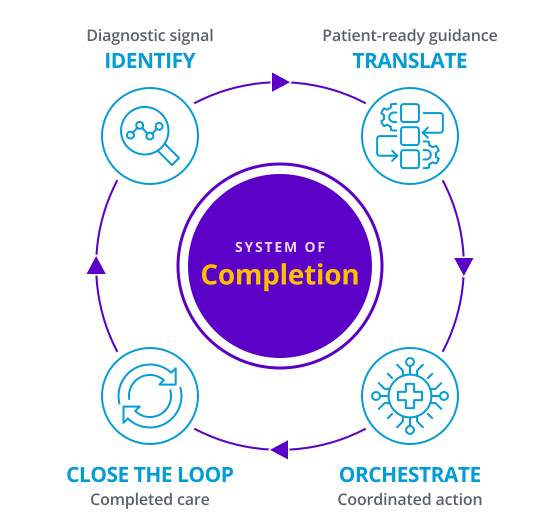
It does four things:
01

Identify

Surface actionable findings and recommended next steps across reports, modalities, and care settings.
02

Translate

Convert clinical language into clear, personalized guidance for patients and a usable signal for care teams.
03

Orchestrate

Coordinate the provider, patient, and scheduling workflows required to move from recommendation to action.
04

Close the Loop

Track every case through completion, auto-close where appropriate, and give health systems real-time visibility into what is done, what is delayed, and what is at risk.
Closed-loop diagram: Identify turns a diagnostic signal into patient-ready guidance through Translate, coordinated action through Orchestrate, and completed care through Close the Loop, then the cycle repeats.

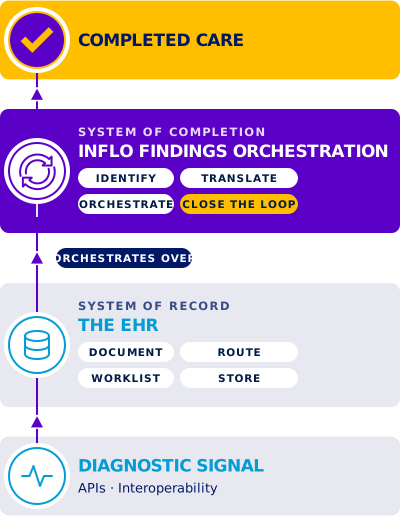
The EHR remains the system of record

Findings orchestration becomes the system that converts clinical context into patient action and completed care.

Why Can't EHR Workflows Close the Last Mile on Their Own?

EHRs are essential infrastructure, but they were not designed to own accountability for care completion.

They document findings. They route messages. They maintain records. What they do not do is reliably create follow-through across fragmented workflows, out-of-network referrals, patient confusion, ignored inboxes, or failed digital outreach.

Tracking is not orchestrating. A worklist is not an outcome.

This gap is also why findings orchestration is gaining visibility and traction. ONC's Cures Act Final Rule required standardized APIs and access to electronic health information making it more feasible to build workflow and intelligence layers above the record without replacing it. CMS's interoperability rule pushed API-based exchange and patient access further.

At the same time, AI has crossed an inflection point. Research published in Nature on large language models showed improving comprehension, knowledge recall, and reasoning in medicine, suggesting meaningful utility when appropriately governed.

The result: the stack now exists to combine interoperability + translation + orchestration + human execution into something operationally meaningful.

Layer diagram: the EHR is the system of record that documents, routes, lists and stores; Inflo findings orchestration sits above it as the system of completion that identifies, translates, orchestrates and closes the loop, leading to completed care.

A Deeper Dive into Findings Orchestration

Does Findings Orchestration Work Beyond Radiology?

Yes, and this is why providers choose Inflo Health.

Inflo's initial deployment focus was radiology follow-up, which remains one of the highest-volume and highest-risk environments for findings loss. But the underlying problem repeats across every diagnostic workflow: a clinically meaningful signal appears, and no operational layer reliably converts that signal into completed action.

The same orchestration model applies to lab, pathology, oncology, cardiology, and other diagnostic findings workflows. The components — identification, translation, orchestration, closure — do not change by domain. What changes is the clinical context each finding carries and the downstream care pathway it requires.

This is why findings orchestration is a better investment than a narrow “incidental findings tool”:
  • One orchestration model across clinical domains
  • Shared governance and reusable workflows
  • Detailed insight into how patients understand results, where they disengage, and which interventions restore follow-through

What Does Findings Orchestration Mean for Patients, Providers, Care Navigators, and Health Systems?

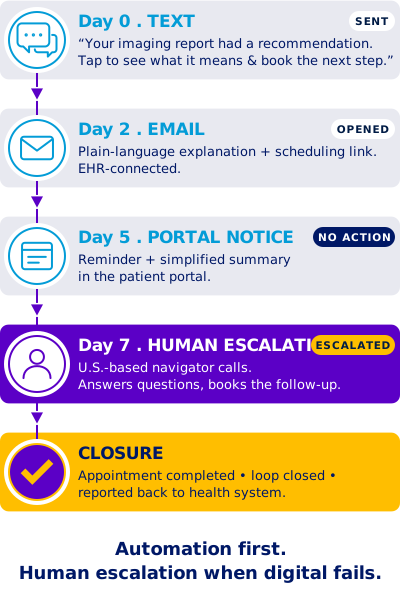
Patient outreach timeline: a text on day 0, an email with a plain-language explanation and scheduling link on day 2, a portal reminder on day 5, a call from a U.S.-based navigator on day 7, then the appointment is completed and the loop is closed and reported.

For patients

Findings orchestration means they understand what was found, why it matters, and what to do next — in plain language, through the channels they actually use, with a real person available when digital outreach isn't enough.

For providers

It means less inbox noise, fewer manual chase-downs, and confidence that clinically meaningful recommendations are moving forward without requiring personal follow-up on every case.

For care navigators

It means less time sorting through 50 patient records to find the two that matter, more time dedicated to answering patient questions and delivering care, and clear visibility into what needs to happen, for whom, and when.

For health systems

It means stronger closure rates, better quality performance, reduced care leakage, more durable governance over one of healthcare's most expensive blind spots, and a clear operational handle on a problem that has historically been managed through hope and labor.

The last generation of health IT was defined by documentation. The next will be defined by whether clinical knowledge becomes action.

Schedule Time with Us

Frequently Asked Questions

What is findings orchestration in healthcare?

Findings orchestration is the operational process that turns a clinically actionable diagnostic finding into completed care. It identifies actionable findings in diagnostic reports, translates them into clear next steps for patients and care teams, coordinates the provider, patient, and scheduling workflows needed to act, and tracks every case through completion. Findings orchestration is not an EHR feature, a patient portal upgrade, or a messaging tool. It is a distinct workflow layer that sits between a diagnostic signal and the action required to resolve it. Inflo Health delivers findings orchestration so that a documented result leads to the care that result calls for.

How is findings orchestration different from an EHR worklist or tracking tool?

An EHR worklist organizes information, while findings orchestration carries each finding through to completed care. EHRs are essential infrastructure: they document findings, route messages, and maintain records. They were not designed to own accountability for care completion across fragmented workflows, out-of-network referrals, crowded inboxes, patient confusion, or failed digital outreach. Findings orchestration coordinates outreach, escalation, workflow routing, reporting, and closure until each case is resolved. Tracking is not orchestrating, and a worklist is not an outcome. With Inflo Health, the EHR remains the system of record, and findings orchestration converts clinical context into patient action and completed care.

What does Results-as-a-Service mean for a health system?

Results-as-a-Service is a delivery model in which the vendor is accountable for outcomes, not just software usage. With traditional software-as-a-service, the health system buys a tool and takes on responsibility for adoption, workflow change, and results. A Results-as-a-Service model combines technology and human execution to make sure a defined outcome actually occurs. For Inflo Health, that outcome is closed-loop care completion: actionable findings are identified, followed up, and tracked until the recommended care is complete. If the loop does not close, the job is not done.

Does findings orchestration work beyond radiology follow-up?

Yes. Findings orchestration applies wherever a clinically meaningful finding needs coordinated follow-up. Inflo Health’s initial deployment focus was radiology follow-up, which remains one of the highest-volume and highest-risk environments for findings loss. The same orchestration model applies to lab, pathology, oncology, cardiology, and other diagnostic findings workflows. The components (identification, translation, orchestration, and closure) do not change by domain. What changes is the clinical context each finding carries and the care pathway it requires. That gives a health system one orchestration model, shared governance, and reusable workflows across clinical domains.

Does Inflo Health replace the EHR or change clinical workflows?

No. Inflo Health does not replace the EHR, and it does not change the radiologist or clinician workflow. The EHR remains the system of record: it documents findings, routes messages, and stores the record. Inflo Health works as an orchestration layer above the record. It reads every report, surfaces every actionable finding, and routes each one into workflows built to the organization’s own protocols and standards. Documented findings become coordinated next steps and completed care, without asking clinicians to work differently.

How does Inflo Health help patients follow through on a diagnostic finding?

Inflo Health helps patients follow through by making the next step clear and easy to act on. It converts clinical language into plain-language, personalized guidance, so patients understand what was found, why it matters, and what to do next. Outreach reaches patients through the channels they actually use, including text message, email, and the patient portal, with a link to schedule the recommended follow-up. When digital outreach is not enough, a U.S.-based navigator calls the patient, answers questions, and books the follow-up. Inflo Health tracks every case until the care is completed.

What results do health systems report with Inflo Health?

Health systems report measurable operational and financial results with Inflo Health. Reported outcomes include an average return on investment of 27X across seven healthcare facilities, a 95% reduction in manual tasks, 100% of actionable findings managed, and 60–90 days to begin closing care gaps. Inflo Health also gives each organization detailed visibility into program performance, operational opportunities, and financial impact, so leaders can see what is done, what is delayed, and what is at risk.

Why do diagnostic findings go unresolved even after they are identified?

Diagnostic findings go unresolved because too many clinically meaningful findings enter fragmented workflows with no true owner of follow-through. For providers, inbox saturation is the root cause: physicians spend nearly 2 additional hours on EHR and desk work for every 1 hour of direct patient care, and alert fatigue leads clinicians to override or ignore warnings in already-saturated systems. For patients, access to information is not the same as understanding or action; releasing a result to a portal does not explain what comes next. That is the findings gap: information is documented, but not reliably converted into understanding, navigation, and completed care.

What are the four steps of findings orchestration?

Findings orchestration works in four steps: identify, translate, orchestrate, and close the loop.

  • Identify: surface actionable findings and recommended next steps across reports, modalities, and care settings.
  • Translate: convert clinical language into clear, personalized guidance for patients and a usable signal for care teams.
  • Orchestrate: coordinate the provider, patient, and scheduling workflows required to move from recommendation to action.
  • Close the loop: track every case through completion, auto-close where appropriate, and give health systems real-time visibility into what is done, what is delayed, and what is at risk.